Introduction to the convolute
Vol.1 - Vol.2 - Vol.3 - Vol.4
List of recipes in volume 1
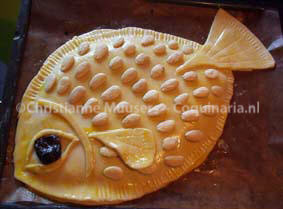 This is the introduction to the edition of the first volume of the four-volume convolute Gent KANTL 15. This first volume was published by W.L. Braekman in 1986 as "Een belangrijke middelnederlandse bron voor Vorselmans’ Nyeuwen Coock Boeck (1560)" (in Volkskunde 87, 1986, pp. 1-24; transl. of title: "An important Middle Dutch source for Vorselmans 'New Cook Book' (1560)").
Because the first volume of this convolute has a common source with the Nyeuwen Coock Boeck by Gerard Vorselman, there will be some references to this text in explanatory notes in the edition and the glossary. This printed cookbook from 1560 was published by Elly Cockx-Indestege, Eenen nyeuwen coock boeck, kookboek samengesteld door Geraert Vorselman en gedrukt te Antwerpen in 1560, Wiesbaden, 1971. (transl. of title: A new cook book composed by Geraert Vorselman and printed at Antwerp in 1560). In the notes and glossary this edition will be referred to as Vorselman.
The copyist
The first volume is almost completely written by one hand (a), with a few small exceptions. In recipe 1.40 the last word ('hant') is repeated in a different hand (w). Recipe 1.42a is written in yet another hand (v). From page 30 onwards the recipe titles are written in another, very ungainly hand (x).
Transcription problems
The writing of hand a has some letters which are difficult to discern from one another. The difference between the Dutch ij and y is very difficult to see. Sometimes ij is topped by two dots, but often not. In making this transcription I have decided to let the position of the letter j (vertical or diagonal) make the difference.
 and
and  are transcribed as ij,
  as y. Braekman also reads
  as y in the word 'eys', but that is the letter x (so: 'exs', an abbreviation of 'edicks' = vinegar). From recipe 29 on this misreading does not occur anymore in Braekman's edition.
Another problem presents itself in the word 'daer' (= there):  (p.3, r.4). This is mostly written as
  (p.3, r.12). Should this be 'dair', or has the upper part of the letter e vanished in the speed of writing?
In the transcription I have chosen 'dair' if the line of the doubtful e was practically vertical. In  (p.3, r.22) the reading is obviously 'dair'.
The edition
The edition is in three columns. The center column contains the Middle Dutch text in diplomatic form, i.e. it has the same use of capitals, interpunction, abbreviations (transcripted in italic) and the line breaks. However, there will be no paleographical or codicological commentary. The place for that is a printed edition.
In the lefthand column is a translation in modern Dutch, in the righthand column you find a translation in English. The translations are working translations, not definitive versions. I have decided to add them anyway, to make the medieval text more accessible. The translations do not follow the syntax of the original to the letter, to be more easily read. Because this is not an annotated edition, I have not offered any arguments in the choice of specific translations. In a printed edition I hope to go more deeply into the meaning of individual words. In the mean time I welcome suggestions or differing opinions anyone has to offer.
The meaning of some Middle Dutch words remains unclear. These words are marked with (?) in the translation. In some places I will add a very short commentary, when a translation is not possible, or the used Middle Dutch word unknown, or used in an unknown capacity. Sometimes I differ with Braekman on how a word should be translated. For the most part I have not marked these differences in the edition, these will be mentioned later in the glossary.
The English translation was made by myself. I am Dutch, not a native speaker of the English language. If you find any mistakes in spelling, grammar or used terminology, please let me know, that I can correct these mistakes. Thank you!
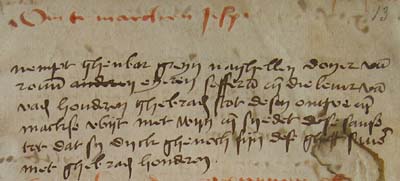
An example of hand a in vol.1 of ms Gent KANTL 15, from page 13 (recipe 1.34)
The contents of volume 1
Below you find a list of the recipes of Volume One of manuscript Gent KANTL 15. As in the edition, there are three columns, from the left with modern Dutch, Middle Dutch and English recipe titles, with links to the recipe in question. The links appear only in the column in the middle. Because the translations appear right next to the original text, this must be sufficient. Medical recipes are marked with an asterisk (*) behind the recipe title.
Transcription and translations by Christianne Muusers.
List of recipes in Volume 1 of Gent KANTL 15
Recipes 1/50 - Recipes 51/92 - Glossary
| 1.1 Om saus zwart te maken 1.2. Om saus geel te maken 1.3. Om groen te maken 1.4. Om blauw te maken 1.5. Om rood te maken 1.6. Om grijs te maken 1.7. Om paars te maken 1.8. Om licht rood te maken in de winter 1.9. Over sauzen 1.10. Om bruine saus te maken bij een haas of zwaan. 1.11. Om groene saus te maken 1.12. Om gele saus te maken 1.13. Om ganselijn te maken 1.14. Om hamelijn saus te maken 1.15. Om komijnsaus te maken 1.16. Om blancmanger te maken 1.17. Een andere blancmanger 1.18. Nog een andere blancmanger 1.19. Saus waar men gebraden eend in legt 1.20. Om doudijnen te maken over gebraden eend 1.21. Om gaverensaus te maken bij gebraden duiven 1.22. Om tremolette saus te maken bij gebraden patrijzen of duiven 1.23. Om suikerij te maken 1.24. Om galentijn te maken 1.25. Om gelei te maken, altijd een pot of "quart" gelei 1.26. Om een sanij te maken voor runder- of varkensstoofvlees 1.27. Om witte saus te maken 1.28. Voor saus bij reigers of bij gebraden kapoenen 1.29. Nog een goede knoflooksaus 1.30. een andere goede eenvoudige witte saus 1.31. Om groene looksaus te maken zonder knoflook 1.32. Om mosterdsaus te maken 1.33. Om saus te maken bij zult, of gebraden duiven, kippen, of ander gebraad 1.34. Om jespi te maken 1.35. Bij gebraden kapoenen of reigers na Pasen 1.36. Saus bij vers wildbraad dat men nat wil geven 1.37. Ganseleij in de winter 1.38. Pepersaus bij gepekeld wildbraad 1.39. Om een dunne komijnsaus te maken voor gezouten varkensvlees en patrijzen/fazanten 1.40. Om een bruine saus te maken 1.41. Om een sorbelet van kippen te maken 1.42. Om een saus bij vers rundvlees te maken. 1.43. Om een bijpeper te maken bij een varken. 1.44. Om een ganselij te maken 1.45. Om een komijnsaus te maken in de vastentijd 1.46. Pepersaus bij bruinvis 1.47. Om een saus van salie te maken 1.48. Om saus met tuinkruiden te maken 1.49. Sint Michiels saus 1.50. Noch een andere saus | [1.] Om sausse suaert te maecken [2.] Om sausse gheel te maecken [3.] Om groen te maecken [4.] Om b[l]aeu te maecken [5.] Om root te maecken [6.] Om graeu te maecken [7.] Om persse te maecken [8.] Om licht root te maecken des wijnters [9.] Van saussen [10] Om een bruijn sausse tot eenen hase of swaenne te maecken [11] Om groen sausse te maecken [12] Om gheel sausse te maecken [13] Om ganseleijn te maecken [14] Om sausse hameleijn te maecken [15] Om comeneij te maecken [16] Om een bammengier te maecken [17] EEn ander blammengier 18. Noch een ander blammengier. 19. Sausse dairmen ghebraden eentvoghel in leet. 20. Om doudijnen te maecken over ghebraeden eentvoghell. 21. Om sausse van gaveren te maecken tot gebraeden duven. 22 Om sausse tremolette te maecken tot ghebraeden velthoenderen ofte duuen [23] Om sucareij te maecken [24] Om galentijn te maecken [25] Om geleije te maecken altijt eenen pot oft quart geleije [26] Om een saneij te maecken tot lummelen van runderen oft van verckenen [27] Om witte sausse te maecken [28] Om sausse tot reijgheren oft tot ghebraiden capuynen [29] Noch een goede loeck sausse [30] Een ander goede ghemeijn wit sausse [31] Om groen loeck te maecken sonder ghemeijn loeck. [32] Om peeckel te maecken [33] Om sausse te maecken tot sult oft ghebraeden duuen hoenderen oft ander ghebraet [34] Om te maecken jespi [35] Tot gebraeden capuijnen oft reijghers nae paesschen [36] Sausse tot virssen wijltbraet dat wijl nat gheuen [37] ganseleij inden wijnter [38] Peper tot ghesauten wijltbraet [39] Om een dunne coemeneij te maecken tot soutte verckenvlees ende velthoenderen [40] Om een bruijn sausse te maecken [41] Om te maecken een sorbelet van hoenderen [41] Om te maecken een sausse tot verssen runtvlees [43] Om te maecken eenen bij peeper tot eenen swijne [44] Om te maecken een gansseleije [45] Om te maecken een coemeneijn jn die vasten [46] Peeper tot meersvijn [47] Om een sausse van sauie te maecken [48] Om sausse van poterie te maecken [49] Sunte michiels sausse [50] Noch een ander sausse | 1.1. To make a sauce black 1.2. To make a sauce yellow 1.3. To make green 1.4. To make blue 1.5. To make red 1.6. To make grey 1.7. To make purple 1.8. To make light red in the winter 1.9. On sauces 1.10. To make a brown sauce for a hare or swan 1.11. To make green sauce. 1.12. To make yellow sauce 1.13. To make ganselijn 1.14. To make sauce hamelijn 1.15. To make cumin sauce 1.16. To make a blancmanger 1.17. To make another blancmanger 1.18. Yet another blancmanger 1.19. Sauce in which roasted duck is laid 1.20. To make doudijnen on roasted duck 1.21. To make sauce gaveren for roasted pigeons. 1.22. To make sauce tremolette for roast partridges and pigeons 1.23. To make suikerij 1.24. To make galentijn 1.25. To make jelly, always a pot or a quart jelly. 1.26. To make a sanij for beef or pork stew. 1.27. To make white sauce. 1.28. Sauce for herons or roast capons. 1.29. Another fine garlic sauce 1.30. Another good simple white sauce. 1.31. To make green garlic sauce without garlic. 1.32. To make mustard sauce 1.33. To make sauce to brawn, or roast pigeons, chickens, or other roast 1.34. To make jespi 1.35. With roast capons or herons after Easter. 1.36. Sauce for roast game to be served moist 1.37. Ganseleij in the winter 1.38. Peppersauce for salt roast game 1.39. To make a thin cumin sauce for salt pork and partridges/pheasants 1.40. To make a brown sauce 1.41. To make a sorbelet of chickens 1.42. To make a sauce to fresh beef 1.43. To make a by pepper to a pig 1.44. To make a ganseley 1.45. To make a cumin sauce during Lent 1.46. Pepper sauce to porpoise 1.47. To make a sauce with sage 1.48. To make a sauce with potherbs 1.49. Saint Michaels'sauce 1.50. Yet another sauce |
| 1.51. Nog een gezonde saus 1.52. Om in boter gebakken eieren verder te bereiden 1.53. Om wildsaus te maken 1.54. Een saus over gebraden elft in de vastentijd 1.55. Om in de zomer verse verjus te maken die gezond is 1.56. Saus voor de maag 1.57. Saus bij ganzen 1.58. Om een zomervulling te maken 1.59. Om vulling in de vastentijd te maken 1.60. Om een vissemaag of iets dergelijks in de vastentijd te vullen 1.61. Om pasteitjes te maken buiten de vastentijd 1.62. Pasteitjes van Sint Bavo 1.63. Om vulling te maken voor gevormde vis buiten de vastentijd 1.64. Om gevormde vis te maken in de vastentijd, en ook kalfsoren 1.65. Om pasteitjes te maken in de vastentijd 1.66. Een pannekoek in de pan op de visdag op de wijze van het gebraad 1.67. Een omelet op visdag 1.68. Om roerei te bakken 1.69. Om Sint Jacobsschelpen te maken, of zonnen 1.70. Om roerei in de vastentijd te maken 1.71. Om een groot ei te maken 1.72. Om appelkoek te maken 1.73. Om eieren in de vastentijd te maken 1.74. Om driekwart pond amandelboter te maken 1.75. Om eieren uit Lombardije te maken 1.76. Om eierkaas te maken 1.77. Om boter te maken van presentkaas 1.78. Om gevormde groene peren te maken 1.79. Om kweeën in een pot te stoven 1.80. Om zacht gestoofde peren te bereiden 1.81. Om kastanjes te bereiden 1.82. Om kweeën in te maken 1.83. Om goede wafels te bakken 1.84. Om wafels te maken op een gedecoreerd wafelijzer 1.85. Om oublies te maken 1.86. Om zacht geroerde eieren te maken 1.87. Om een appeltaart te maken of een venkeltaart te maken 1.88. (Om fijne hypocras te maken) 1.89. Gewone hypocras voor een gelt 1.90. (Om) eenvoudige hypocras te maken 1.91. Om een drank te maken voor zieke/zwakke mensen 1.92. (Om wijn aan te lengen) | [51] Noch een gesonde sausse [52] Om eeijeren jn die boter gedoept voirder te bereiden [53] Om venisoen sausse te maecken [54] een sausse ouer ghebraeden elst jn die vasten [55] Om des soemers groen virjius te maecken dwelck gesont is [56] Sausse voir die maeghe [57] sausse tot ganssen [58] om soemerwulsel te maecken [59] Om vulsel in die vastene te maecken [60] Om eenen rop of desgelijcks jn der vasten te vullen [61] Om roffioelen te maecken buijten der vasten [62] Roffioelen van sunter baefs [63] Om stoffe te maecken tot gheformde visch buijten der vasten [64] Om gheuormde wijs te maken in die wasten ende ook calfsoeren [65] Om roffiollen [..] maken jn die wasten [66] Een rasschoen jn die panne des wijsdachs nae dat ghebrat [67] een eyer smaut op wijsda[c]hs [68] om ghecrolden struijuen te backen [69] Om scholpen van sunte jacops te maken oft sonnen [70] Om ghecrolden strujuen jn die vasten te maken [71] Om en grot ey te maken [72] om appelkock te maken [73] om eyeren in die wasten te maken [74] Om drie wirdelpons mandelboter te maken [75] om eyer lombaert te maken [76] om eyer kees te maken [77] Om boter te maken van present [78] om grien peren te maken jn wormen [79] om queen jn enen pot te stouen [80] om morue ghestofde peren te bereyden [81] Om karstandijen te bereyden [82] Om queen te sulten [83] Om ghode waffellen te backen [84] Om waffellen te maken tot enen ghetralden jsere [85] Om nwelen te maken [86] Om muruen gherurden eyeren te maken [87] om en appeltart te maken of een wenkl tart te maken [88] (Om te maken finen ipencras) [89] ghemeyn jpen cras tot een ghelte [90] sclecht jpencras te maken [91] Om te maken enen dranck voer kranken mensen* [92] (Om wijn te breken) | 1.51. Another healthy sauce 1.52. To further prepare eggs fied in butter. 1.53. To make sauce for venison 1.54. A sauce over fried allis shad during Lent 1.55. To make fresh verjiuce in the summer which is healthy 1.56. Sauce for the stomach 1.57. Sauce for geese 1.58. To make a summer stuffing 1.59. To make stuffing during Lent 1.60. To stuff the stomach of a fish or something like that during Lent 1.61. To make pasties when it is not Lent 1.62. Pasties from Saint Bavo 1.63. To make stuffing for shaped fish when it is not Lent 1.64. To make shaped fish during Lent, and also calf's ears 1.65. To make pasties during Lent 1.66. A pancake in the pan on the fishday in the manner of a roast 1.67. An omelette on fishday 1.68. To bake scrambled eggs 1.69. To make scallops or suns 1.70 To make scrambled eggs in Lent 1.71. To make a large egg 1.72. To make apple cake 1.73. To make eggs during Lent 1.74. To make three-quarter pound of almond butter 1.75. To make eggs from Lombardy 1.76. To make cheese from eggs 1.77. To make butter from "present" cheese 1.78. To make shaped green pears 1.79. To stew quinces in a pot 1.80. To prepare soft stewed pears 1.81. To prepare chestnuts 1.82. To conserve quinces 1.83. To bake good wafers 1.84. To make wafers with a decorated wafer iron. 1.85. To make wafers 1.86. To make soft scrambled eggs 1.87. To make an applepie or a fennel pie. 1.88. (To make fine hypocras) 1.89. Common hypocras for a gelt 1.90. To make simple hypocras 1.91. To make a medicine for ill/weak people 1.92. (To dilute wine) |